
VIPS is the Vaxelrod Intellectual Proprietary System, a purpose-built compliance platform for federal and state procurement teams operating with AI. The platform runs in production and pilot engagements are open. This page reflects the program as it stands today.
Federal procurement is governed by thousands of provisions distributed across the FAR, agency supplements, and program-specific clauses, a regulatory surface no team can hold in working memory. VIPS is the assurance layer that helps procurement teams operate with AI while producing an audit-grade record of every action. The same engine verifies state procurement law in Virginia, Maryland, and the District of Columbia, because the businesses and agencies we serve do not stop at the federal line.
Procurement teams operate under deadline pressure against a shifting regulatory baseline. AI tools accelerate the work, but acceleration without provenance only relocates the risk downstream to audit. If a decision can't be defended, it shouldn't be made.
VIPS is engineered around a single principle: every action is recorded before it's released, and every change is gated before it's merged. The platform is designed to be defensible by construction.
A complete chain of custody from source authority to final action, preserved under regulatory-grade retention. Auditors don't ask what happened. They review the record. Fraud, waste, and abuse are not hunted after the fact; they are stopped at intake, gated at decision, and exposed by a ledger that cannot be quietly edited.
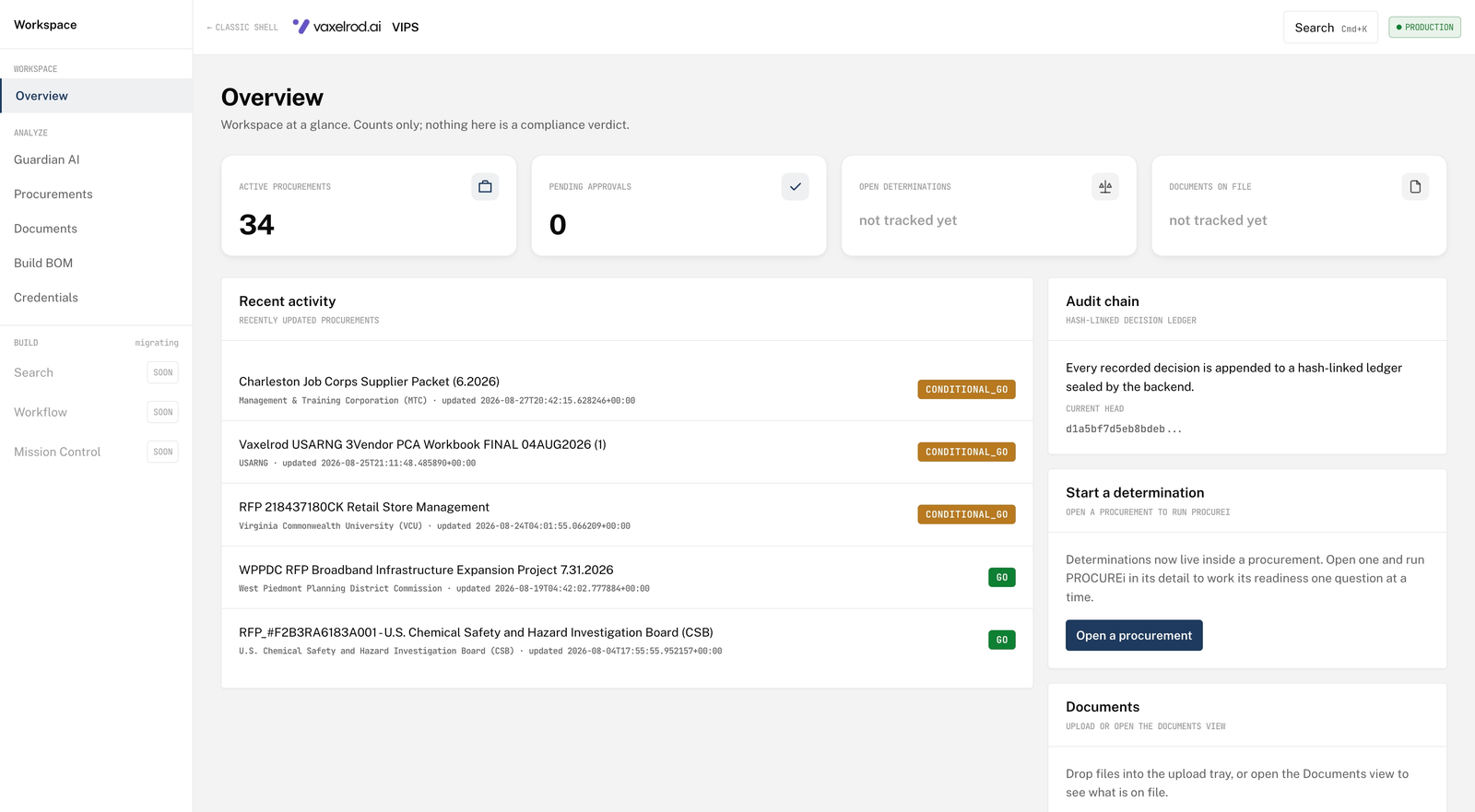
Most AI tools in government contracting are generative copilots: fast, fluent, and unaccountable. They will fill a gap in the record with a plausible guess, because that is what generative models do. VIPS is engineered to do the opposite. Same question, two different machines.
"Yes, this flowdown almost certainly applies here. Based on similar contracts, you should be fine to proceed with the standard language..."
Required source not in the record. VIPS returns a structured diagnostic identifying exactly which document is missing and what determination it blocks.
| Dimension | Generative copilots | VIPS |
|---|---|---|
| Output | Fluent prose with unverifiable confidence | PASS / FAIL / INCONCLUSIVE, grounded only in retrieved source text with pinpoint citations |
| Missing data | Fills the gap with a plausible guess | Refuses to attest. Stops, reports what is missing, and escalates to a human |
| Verification | Self-reported confidence scores | Gated checks before release. Changes that cannot demonstrate they preserve the platform's guarantees do not ship |
| The record | A chat history | A tamper-evident, chained record of every material determination, preserved under regulatory-grade retention |
| In audit | Reconstruct what the tool probably did | Replay the record. Complete chain of custody from source authority to final action |
| Model disagreement | One model, one opinion | Multi-model arbitration. Conflicting outputs are detected and resolved before anything is released |
| Who can check it | Take the vendor's word | The record can be independently verified. A sealed package carries the evidence, the rules applied, and the signature needed to check the determination |
The centerpiece of the VIPS v8.0 program: a unified evidence engine that transforms how procurement documents become defensible determinations.
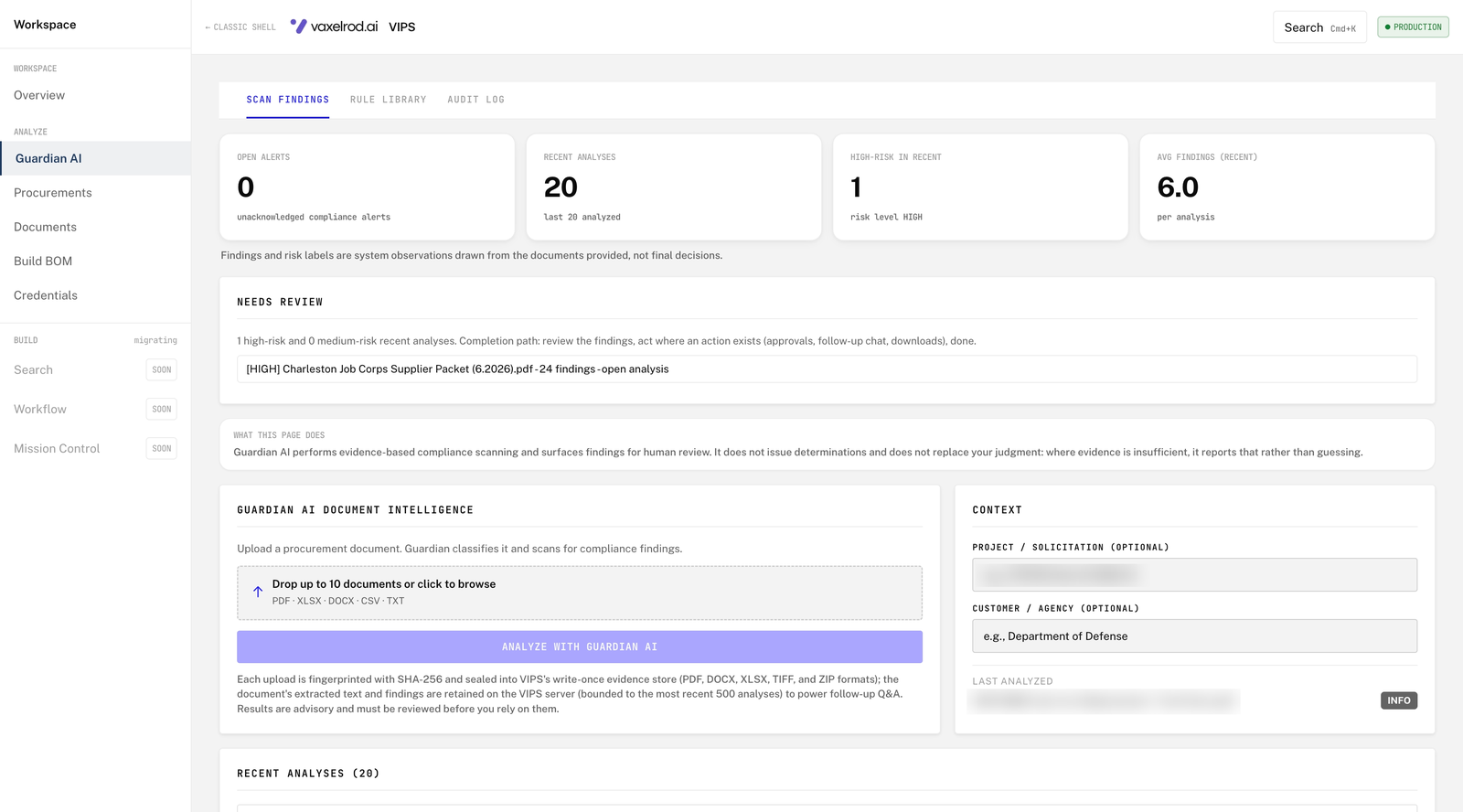
Today, VIPS verifies rules against documents. FORGE makes the documents themselves first-class evidence. Every file that enters the platform passes through a zero-trust pipeline: validated, sealed, classified, and shredded into citable evidence objects before a single determination is made, with provenance tracked from first byte to final finding. The engine is running in production. Every PASS, FAIL, or INCONCLUSIVE it issues is signed, chained to the one before it, and reproducible end to end from the exact sealed bytes it was derived from.
Zero-trust upload with format and integrity validation.
Hashed into write-once storage. The record of record.
Document type and jurisdiction identified automatically.
Decomposed into discrete, addressable evidence objects.
Every determination bound to pinpoint evidence.
Reproducible findings with full provenance.
The shapes FORGE produces are versioned and frozen. A change is a new version with a recorded supersession, never a silent edit to what an auditor already relied on.
The rules governing when partial evidence may and may not support a conclusion are stated as mathematical propositions and checked by a proof assistant. The proof is rebuilt on every change and the build fails if it drifts.
Each determination is cryptographically signed and chained to the previous one for that customer, so the order and integrity of a determination history can be checked after the fact by someone who was not there when it was made.
When evidence is missing, conflicting, or requires human judgment, FORGE issues a sealed refusal that records why, at what severity, and what would resolve it. An honest refusal is a product, not a failure.
A sealed determination record can be independently verified against the evidence it cites and the rules it applied. The answer is verified, invalid, or unverified. There is nothing in between and there is no partial credit.
FORGE runs on versioned, frozen data contracts and machine-checked decision logic. Nothing issues before it is recorded. The ledger entry is written first. Those rules are properties of the system that can be independently checked, not claims on a slide. The build fails if the checked logic drifts from the logic that was proven.
An auditor, a protest reviewer, or a program office can trace any finding back to sealed source bytes and re-run the determination. Compliance stops being an assertion and becomes a reproducible result.
FORGE applies the same evidence standard to federal, state, and district rules alike. New jurisdictions plug into the engine as cited rulesets; the pipeline never changes.
The FORGE Engine is running in production inside the VIPS v8.0 program. Sealed intake, signed determinations, and independent verification of sealed records are live today. Cross-cloud verification is in build. Capability briefings on the v8.0 roadmap are available under NDA.
Today, the system that produces a VIPS determination and the tool that verifies it both run inside infrastructure Vaxelrod controls. That is a fair question for any inspector general to ask, and the answer we are building is architectural rather than rhetorical.
The evidence vault, the signing authority, and the determination gate stay on one provider, under write-once retention, with a single point of issuance. Multi-cloud does not mean scattering the authoritative record across vendors. Splitting the record would weaken it, so we did not split it.
A verification job runs in a second cloud, in a separate trust domain, holding no credentials into the account that produced the determination and no privileged network path back to it. It receives only the exported package, handed over as a file, and re-runs a pinned verifier and a pinned proof toolchain against it.
If verification succeeds on infrastructure that cannot reach ours, the determination rests on the evidence and the mathematics rather than on trust in the vendor. The same job can be run by an assessor, an inspector general, or a prime contractor on their own infrastructure. That is the intended end state.
We did not put the sealed evidence behind another provider's analytics engine, and we did not let a probabilistic filter stand in for a deterministic gate. Services that would have required granting outside compute read access to sealed evidence were declined. The verifier's value comes precisely from what it is not permitted to reach.
Sealed intake, signed determinations, and independent verification of sealed records are running in production today. Verification in a second cloud trust domain is authorized and in build under the v8.0 program.
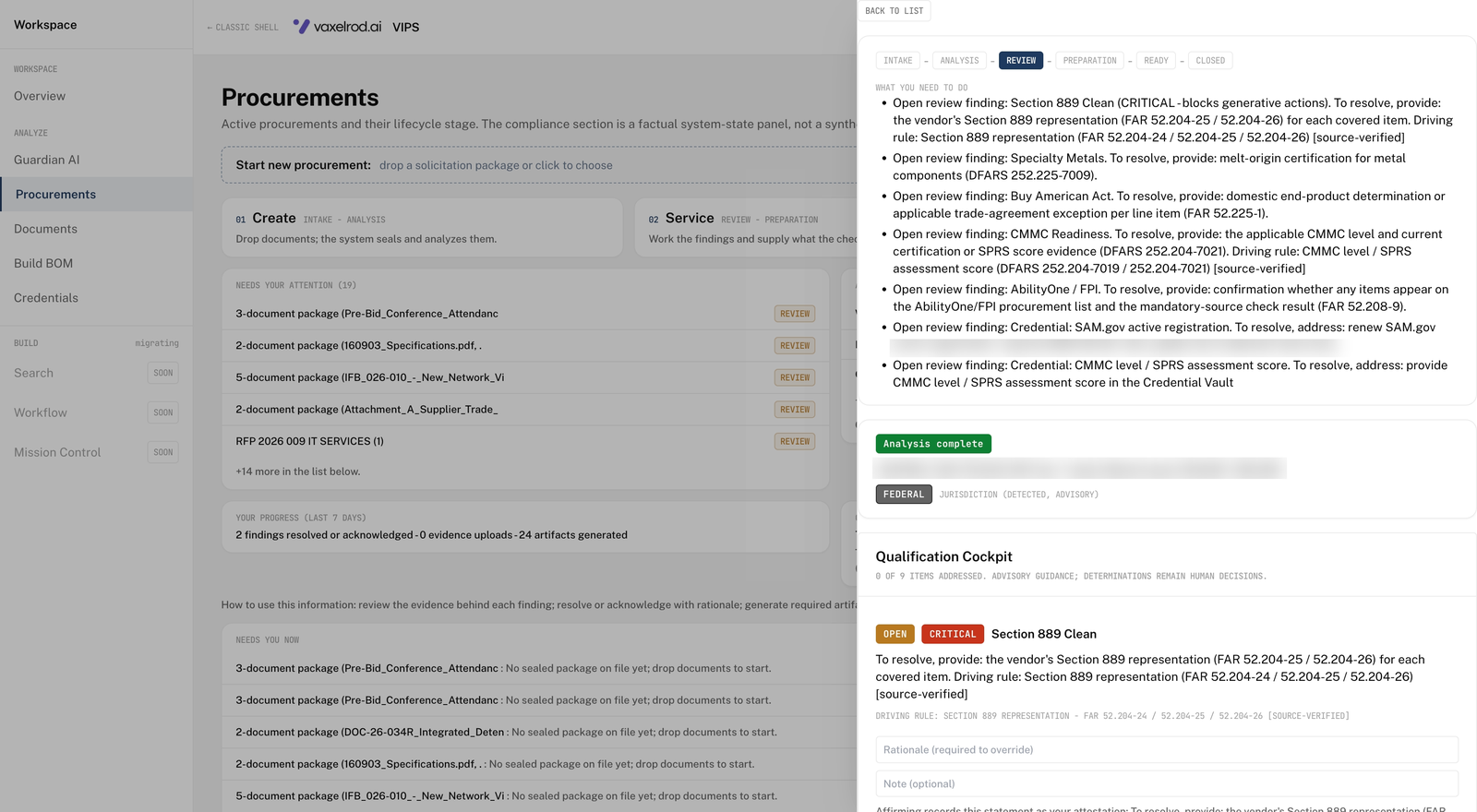
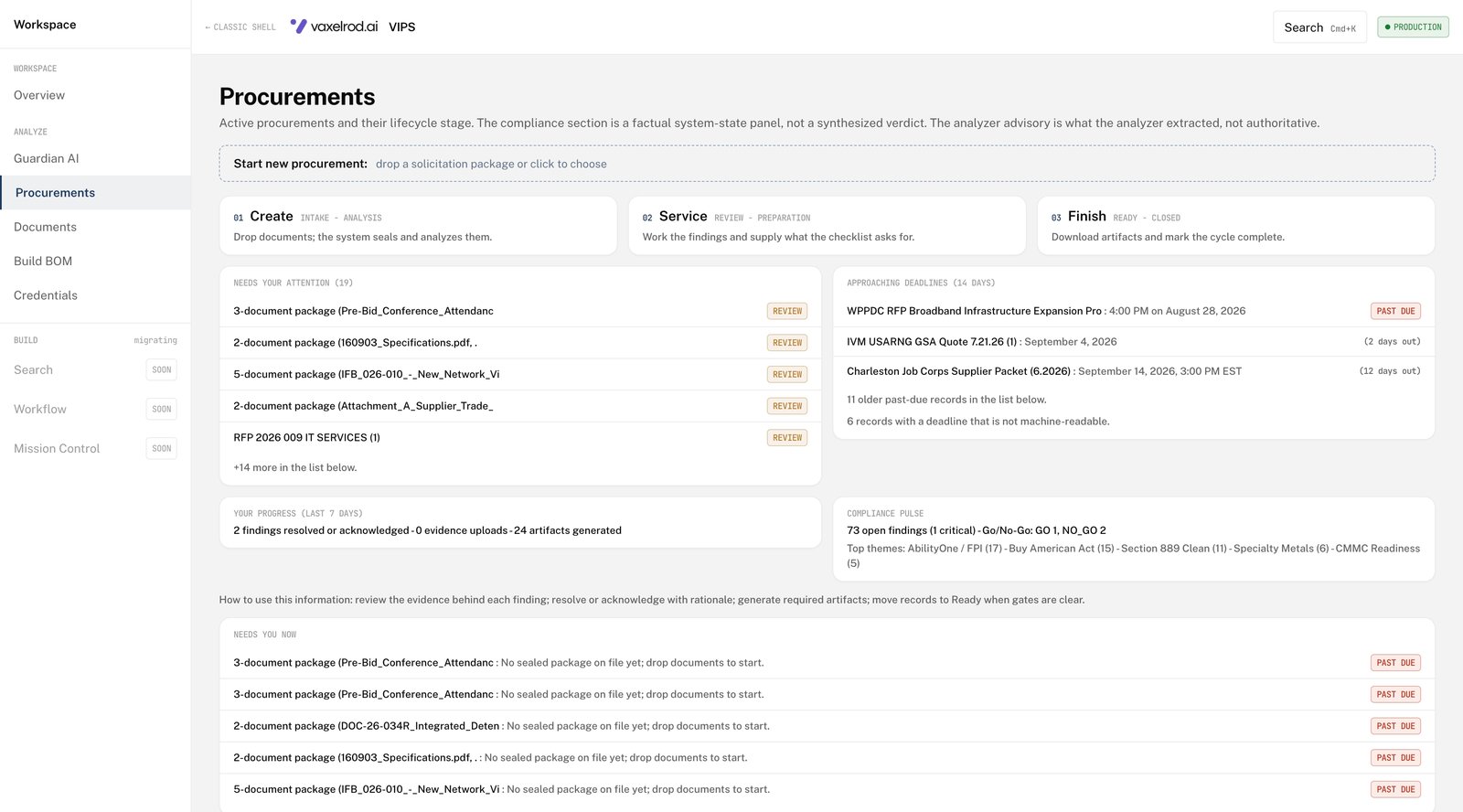
Reviews of a contractor's purchasing system do not ask whether a company understands the regulation. They ask whether each purchase file contains the documents that file is required to contain, with the right approvals, at the right thresholds, in the right order. VIPS now carries purchasing-file checklists the same way it carries jurisdiction rules: as versioned, cited rulesets over sealed evidence.
Each item is versioned and each threshold is dated and cited. A correction ships as a new version with a machine-readable difference from the last, never as a silent edit.
A file is evaluated as a whole. Its readiness is PASS, FAIL, or INCONCLUSIVE across the items inside it, and it cannot reach PASS while a mandatory item lacks evidence.
There is no readiness percentage and no letter grade, because a number invites an argument the evidence cannot settle. The output is a state and the reasons for it.
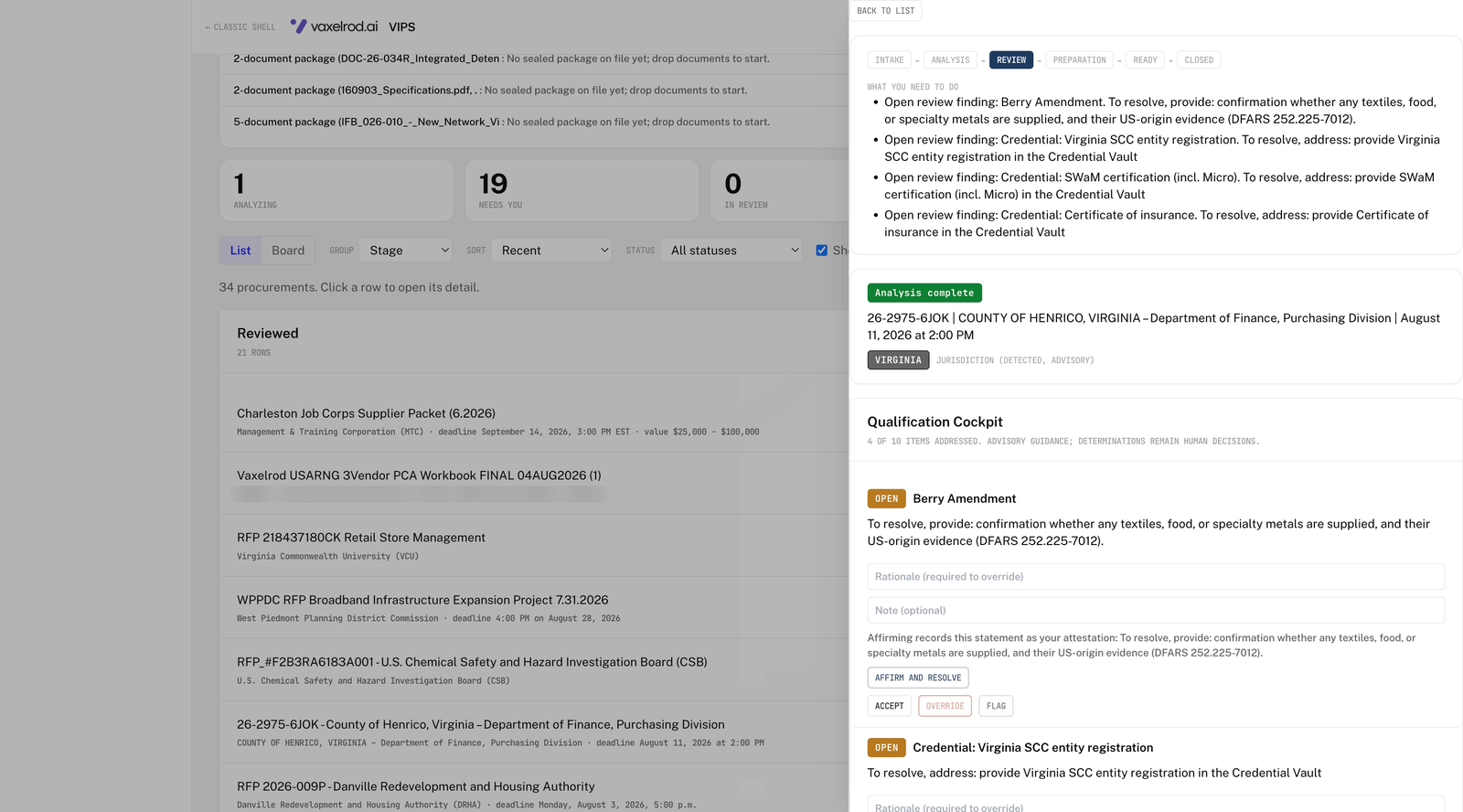
Mechanical checks are automated. Whether a document is adequate, whether a not-applicable rationale holds, and the final attestation all require a person, and each confirmation is recorded with who confirmed it, when, and against which item.
Anything a model read out of a document stays unresolved until a person confirms it or a deterministic source supplies it. Items that depend on it stay INCONCLUSIVE until then. This is the rule that keeps a fluent guess from becoming a file entry.
VIPS fills the checklist the organization already uses and records a hash of both the blank template and the finished document, so the paperwork can be checked against the record instead of taken on faith.
VIPS annotates the file. It does not block the purchase.
VIPS is delivered as an integrated platform serving federal and state jurisdictions alike, but our discipline is summarized in a few simple commitments. The technical implementation sits behind NDA and is shared with qualified partners during briefing.
Every action the platform takes is captured to a tamper-evident record before it reaches the world. Replay is not a feature; it is the contract we hold with every operator and auditor.
When the platform changes itself, those changes are gated. We do not ship modifications that cannot demonstrate they preserve the platform's stated guarantees.
When the platform is not confident enough to act safely, it does not act. The case is escalated to a human reviewer with the full context attached. Caution is the default.
Records are preserved under regulatory-grade retention. Even our own operators cannot mutate the historical record once it is committed. The audit trail is structurally protected.
VIPS advances under the v8.0 program. The FORGE evidence engine has shipped and is running in production, and pilot engagements are open. We are in production and we are specific about the line between what is shipped and what is not. This section reflects what is shipped, what is in build, and what is next.
In production on AWS since 2025.
Vaxelrod is building VIPS in partnership with industry programs that support the next generation of AI infrastructure for mission-critical work.
Vaxelrod is a member of the NVIDIA Inception program, an accelerator for startups building with AI infrastructure. The program supports access to technical resources, GPU compute, and ecosystem partnerships.
Building federal-grade AI infrastructure takes more than software. It takes alignment with the partners who provide the substrate. As an NVIDIA Inception member, Vaxelrod has access to the technical resources and ecosystem support that inform how VIPS is built.
We are selective about partnerships and disclosures. Detailed technical architecture, model selection, and implementation specifics are shared only with qualified partners under non-disclosure.
Vaxelrod LLC is the R&D and Intelligence Division of UTG Companies Inc., a federally registered woman-owned small business with active SAM.gov status and a verified contracting profile.
Our supply desk runs on VIPS. Every order we fulfill closes with one sealed purchase file: quote, price analysis, purchase order, invoice, and serial numbers.
We work with federal program offices, prime contractors, and procurement teams ready to operate with verifiable AI. Briefings are held under NDA. Pilot engagements are open now: sixty days, fixed fee, one workflow, defined deliverables at day one and day sixty.